
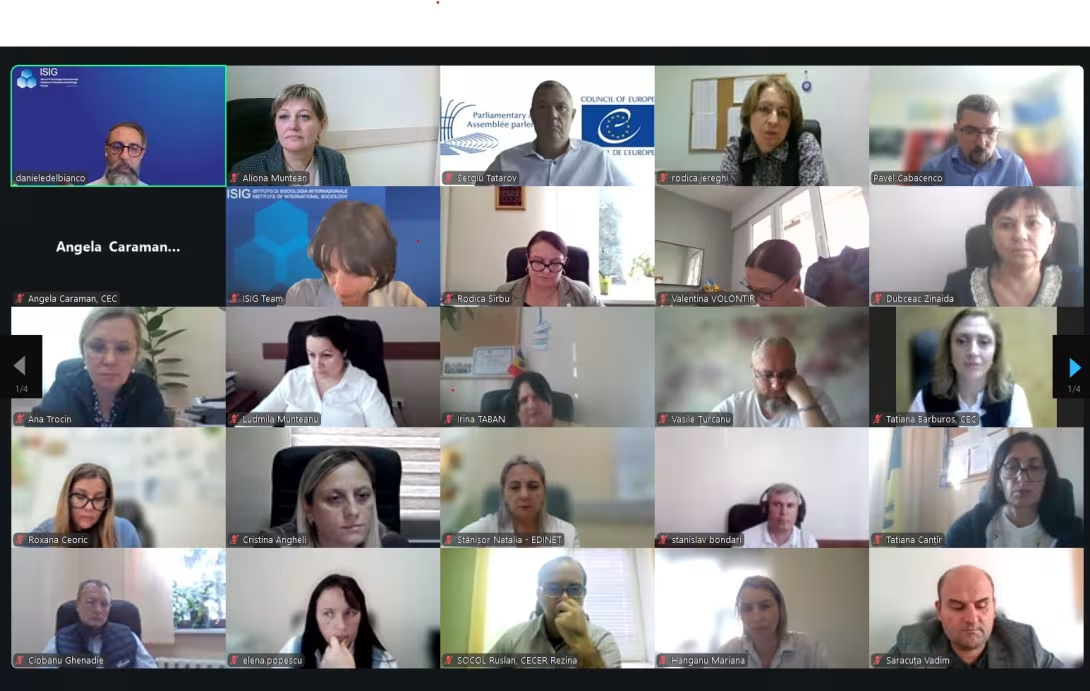
On September 17, 2026, I participated in the URSO 2026 validation webinar, organized within the framework of the Council of Europe project "Improving Electoral Practices in the Republic of Moldova - IEPRM (2025-2028)."
The activity brought together representatives of the Central Electoral Commission, chairpersons of the level II electoral councils, representatives of the Council of Europe, as well as national and international experts and consultants. The event's agenda included a complex process of evaluation, institutional validation, and strategic reflection, aimed at analyzing the current cycle of institutional development and preparing for the next strategic period 2027-2032.
The webinar is part of the URSO 2026 process, through which the implementation of the Central Electoral Commission's current Strategic Program is evaluated. The analysis is based on the URSO Benchmark, document analysis, consultations with stakeholders, and information collected during the evaluation process, so that the preliminary conclusions reflect as faithfully as possible the experience and needs of the electoral administration.
The webinar was opened by Angelica Caraman, President of the Central Electoral Commission, and Sergiu Tatarov, project manager of the Council of Europe Office in Chișinău. The working sessions were facilitated by experts and consultants Daniele Del Bianco, Ramona Velea, and Pavel Cabacenco.
Several objectives were pursued during the activity: presenting the main results of the evaluation of the current Strategic Program, identifying institutional achievements and challenges, clarifying areas that require further analysis or interventions, and validating preliminary conclusions together with representatives of the electoral administration. Additionally, discussions focused on how the evaluation results can underpin future priorities, recommendations, and strategic indicators for the period 2027-2032.
Distinct attention was given to the relationship between the institutional and operational maturity of the electoral administration, systemic and inter-institutional challenges, and areas that require strengthening. Participants analyzed both the capacities directly under the control of the Central Electoral Commission and external factors that may influence the achievement of strategic objectives.
The validation process also included interactive exercises through the Mentimeter platform, which allowed participants to express their opinions on the preliminary conclusions, highlight achievements that need to be maintained, areas that require strengthening, and aspects that should be reflected in the next strategic cycle.
In the section dedicated to future perspectives, participants reflected on areas where continuity is necessary, strengthening existing interventions, or adopting new strategic approaches. Priorities for the future planning cycle were discussed, as well as the analytical and operational actions needed to finalize the evaluation and prepare for the next stage of strategic development.
The project "Improving Electoral Practices in the Republic of Moldova (IEPRM) 2025-2028" aims, in general, to increase public trust, credibility, and legitimacy of electoral processes by enhancing their transparency, inclusiveness, and integrity. The Council of Europe also specifies that one of the project's directions is to support the CEC and electoral bodies in evaluating current strategic programs and in developing the next strategic cycle, including through the use of the URSO methodology.